
How Arrest Warrants Work in Cherokee County
Iowa Code section 804.1 sets the machinery in motion. A complaint goes before a magistrate. When the complaint and its supporting affidavits establish probable cause that an offense occurred and the designated person committed it, the magistrate issues the warrant. Probable cause simply means the facts give a legal basis to believe the offense took place. Sometimes a citation replaces a warrant. The same section also covers willful failure to appear after a served citation and permits an earlier warrant when someone is unlikely to show up. The local docket controls the actual case in Cherokee County. The sheriff posts no public warrant roster here. A Cherokee County warrant lookup therefore means pairing Iowa Courts Online with case-specific confirmation from the court.
Cherokee County Probable-Cause Sequence
Court action and police service stay separate. A complaint and affidavits go to the judicial officer, who weighs whether the showing amounts to probable cause in Cherokee County. If it does, the warrant is issued and directed to a peace officer. Service follows, then a return records what occurred after delivery.
These are different facts. In Cherokee County, an arrest entry, a warrant event, a service record, and a court disposition answer separate questions, so a portal hit alone never means someone is currently wanted.
Arrest Warrants: What They Contain
Section 804.2 spells out what an Iowa arrest warrant must contain. It runs to any peace officer in the state. The document gives the offense by name or general description, the issue date, the county or city where it was issued, and the magistrate's signature. A Cherokee County warrant follows that same form. Under section 804.3, a bailable matter may also carry an endorsed bail amount and conditions.
The public docket may show related fields without displaying the complete warrant instrument, and confidential filings can also be withheld. Ask the Cherokee Clerk which public record is available.
Cherokee Arrest-Warrant Access Routes
Begin at Iowa Courts Online for public case and docket information. Searches run by name, case ID, or citation. For current status, call the Cherokee County Clerk of District Court at 712-225-6744. The clerk confirms the official public court record, clarifies the case type, and explains courthouse-terminal and copy access. The Cherokee County sheriff answers service questions at 712-225-6737. The jail takes custody questions at 712-225-6738. Cherokee, Marcus, and Aurelia each run their own police contacts. City matters go through those departments rather than Cherokee County offices. The restricted IOWA System stores wanted-person and warrant-related information for criminal-justice agencies, not public search, and a DCI criminal-history check is not a warrant-status lookup either.
How Warrants Get Served in Cherokee County
Under section 804.4, a warrant may be delivered to a peace officer and served anywhere in Iowa. A warrant issued in Cherokee County reaches past county lines. Who actually serves it depends on where the warrant is entered, where the person is encountered, and how agencies coordinate. The Sheriff handles county patrol and service. City police handle their own lawful duties. After an arrest, section 804.21 requires presentation without unnecessary delay to the nearest or accessible magistrate. The officer endorses the return. Release can follow an endorsed bail amount or applicable guidelines, or a judicial officer can set case-specific terms. That statewide rule fixes no timeline. Surrender methods and bond amounts in Cherokee County come from the court on the specific case, not from the rule alone.
Cherokee County Confidential Warrant Materials
Iowa Code section 804.29 keeps the information filed to obtain an arrest warrant confidential until the statutory release event tied to arrest, return, or initial appearance. Other sealing and dissemination rules can still apply. Juvenile matters carry separate protections. So a missing online result in Cherokee County may reflect the law rather than a technical error. The Judicial Branch public-record request route asks requesters to identify the right custodian and describe the record with enough detail to locate it. Requests may be oral or written. Complex ones may need writing, and retrieval, review, redaction, copies, postage, or programming can carry reasonable costs. Cherokee County sets no warrant-specific request fee.
Arrest Warrants, Summonses, and Bench Warrants
These three terms mark different paths. An arrest warrant authorizes arrest after probable-cause review. A summons directs a person to appear without authorizing immediate arrest in the same way. In Cherokee County practice, bench warrant is shorthand for a court-connected warrant, often tied to a missed appearance or an unmet order in an existing case.
| Process | Starting point | Required response |
|---|---|---|
| Arrest warrant | Probable-cause complaint | Agency service and court process |
| Summons | Formal notice to appear | Appear as directed |
| Bench warrant | Existing court obligation | Issuing-court resolution |
| Search warrant | Chapter 808 investigation | Not a personal arrest-status record |
The bench warrant lookup addresses failure-to-appear records and court-controlled recall steps.
Cherokee Arrest and Search Warrants Differ
An arrest warrant under chapter 804 authorizes taking a person into custody. A search warrant works differently. Chapter 808 authorizes a search for the property or evidence described in the judicial process. Search-warrant applications and affidavits follow their own confidentiality framework. A case code such as SW marks a search matter. It is not proof of an arrest warrant in Cherokee County. Iowa has expanded electronic search-warrant capability statewide, and the Supreme Court orders page records recent filing and return changes.
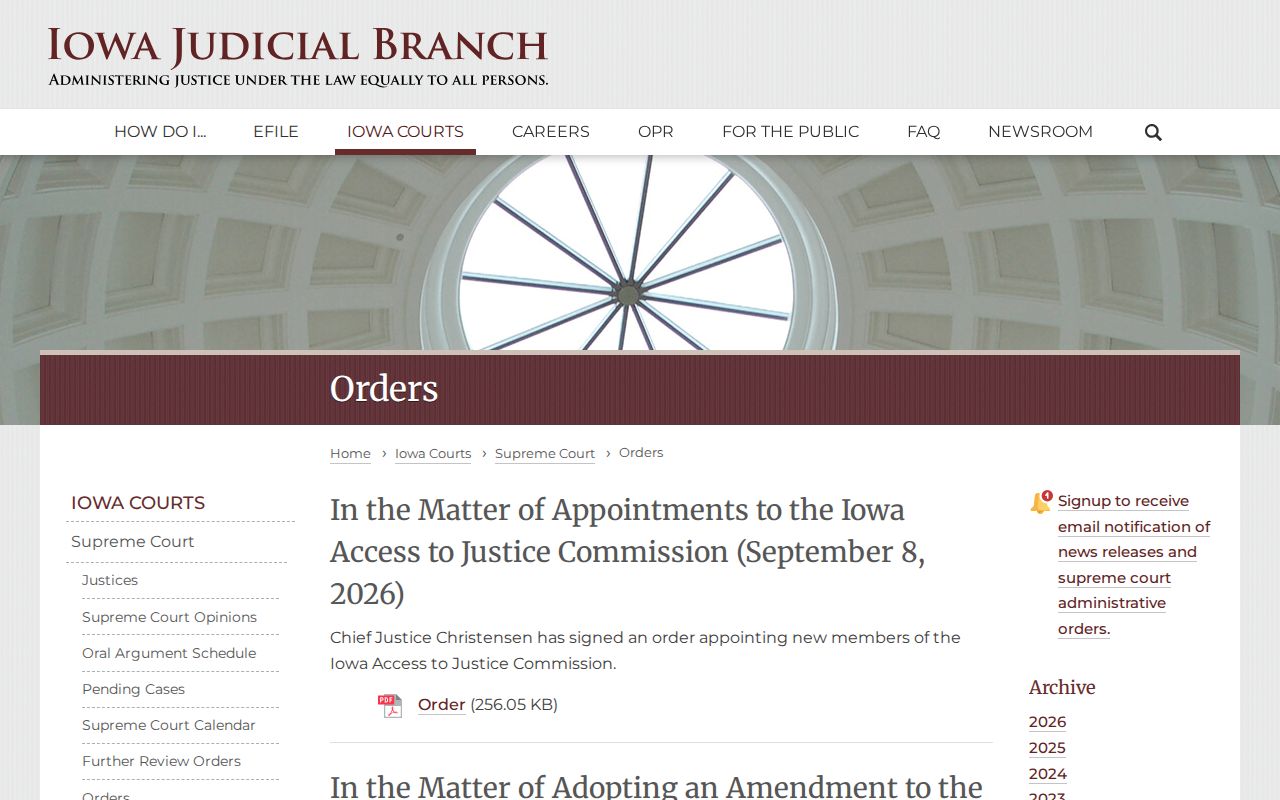
Dated orders on the docket trace court workflow in Cherokee County. They are not a public arrest-warrant portal, so ask the clerk about any code or event you do not recognize.
Cherokee County Bond Needs Confirmation
The statewide uniform bond schedule lists reference amounts by offense class. It applies mainly in limited after-hours settings. It does not guarantee any figure in a Cherokee County warrant case. Some categories carry no scheduled bond and await judicial review. Even then, a judicial officer who has seen the person is not bound by the schedule. Chapter 811 and the court's own order control release. Treat the official bond schedule as guidance for its stated purpose only. Cherokee County bond-window hours, payment methods, surety lists, and release times are not published. The court payment portal is not a universal bond channel. Before attempting an appearance on a Cherokee County warrant, confirm the correct procedure with counsel, the clerk, or the jail.
Handling an Arrest Warrant in Your Name
A no-result screen proves nothing. Neither does an old docket printout or a third-party site. Start by identifying the alleged case through official public records. Then confirm which court or agency issued the warrant. An Iowa attorney can advise on contact, appearance, bond, and filings, since court staff cannot give legal advice. Do not show up unannounced in Cherokee County before the risk and procedure have been checked.
- Record the official case ID and court shown.
- Ask the clerk what public order is current.
- Ask counsel how to arrange the next lawful step.
- Use the Sheriff or city agency for service routing.
- Keep written or docket proof after court action.
Act carefully: Only the issuing court or responsible agency can confirm whether a Cherokee County arrest warrant is active, served, or recalled.
Federal cases take a different route. PACER and the Northern District of Iowa offer docket access, and the U.S. Marshals Service handles federal fugitive work. A Cherokee County warrant search cannot resolve federal status.
Cherokee Arrest-Warrant Record Check
A careful final check keeps the court file separate from the agency entry. First confirm the Cherokee County case through Iowa Courts Online or the Clerk of District Court. Ask which public document shows issuance. Ask whether a service return has been filed. Ask whether a later order changes the process. Then take the service question to the Sheriff or the originating police agency, because the docket cannot answer it. Two sources matter here. The public index may lag, and the IOWA System is restricted. Keep the terms precise. Issued means a judicial officer signed the warrant. Served means a peace officer executed it. Returned means the officer reported back to the court. Recalled or quashed takes court action, and a bond or payment field replaces none of these. If access is limited under section 804.29 or juvenile rules, ask what can be released and when. Anyone checking their own case should talk with Iowa counsel before appearing. No walk-through program, amnesty event, fixed surrender schedule, or warrant clearance charge operates in Cherokee County, so directions must come from the case itself.