
Cherokee Warrant Checks
No single search box covers a Cherokee warrant check. Cherokee splits the work across offices, so begin with the agency tied to the event and then follow the paper into the court record. Cherokee Police answers city police questions, while Iowa Courts Online supplies the public docket index. The Cherokee Clerk holds the official court file. The Sheriff handles county service and custody. Each channel carries a different piece of the record. Exact identifiers help a lot here. A spelling change, a new filing, an old case, or a confidential matter can sink a plain name search in Cherokee. A docket hit is only a lead. Only the issuing court or serving agency can say whether a warrant stands active, served, recalled, or quashed. Quashed simply means the court set it aside.
- Ask Cherokee Police which agency holds a city-originated incident or service record.
- Search Iowa Courts Online by name, exact birth date, case ID, or citation number.
- Call the Cherokee Clerk at 712-225-6744 when the entry is unclear or absent.
- Contact the Sheriff at 712-225-6737 for county service questions.
- Ask the court or an Iowa attorney how to address a possible warrant before visiting in person.
Cherokee's City and County Crossroads
Cherokee is a city and the county seat at once. Its 2020 population was 5,199. That Census figure explains why the city gets its own page. It says nothing about warrants or court activity. City police, city hall, the courthouse, the clerk, the sheriff, the jail, and the communications center all sit in Cherokee. They stay separate offices with separate jobs, so a Cherokee warrant question may touch several of them.
City route
Cherokee Police: 239 W Maple Street. City Hall: 416 W Main Street, 712-225-5749.
Court route
Clerk of District Court: 520 W Main Street, 712-225-6744.
County route
Sheriff: 111 N 5th Street, 712-225-6737.
Name the record type first. That choice points you to the right desk in Cherokee. Parking stays with the city clerk. A filed citation, criminal case, bond entry, or municipal infraction travels the District Court route. Law-enforcement service belongs to police or sheriff.
Policing and Courts in Cherokee
Cherokee Police and the Cherokee County Sheriff's Office are separate agencies. Police work city incidents and serve process within their authority. The Sheriff covers county functions, the jail, communications, and rural patrol. Neither office posts a public active-warrant roster. One phone call never replaces a court-file check once a case is filed. Iowa has no separate Cherokee municipal court either. The Judicial Branch traces that to the 1973 Unified Trial Court Act, which abolished the old municipal, mayor's, and police courts. City ordinance matters and municipal infractions now enter Iowa District Court. A magistrate may handle scheduled violations, simple misdemeanors, municipal infractions, and preliminary matters. City parking is the one exception, and it stays with the city clerk.
Cherokee Warrant Search Controls
Iowa Courts Online trial-case search is the main tool for a Cherokee warrant lookup. It offers name, date-of-birth, case-ID, and citation modes. A name query needs at least two letters of the last or firm name. First name is optional, spelling matters, and a percent sign works as a wildcard. Date-of-birth mode wants the exact date plus both names. Case-ID search needs the county and case type. Iowa's help describes a 17-character ID and warns that the letter O and zero differ. Codes like FE, AG, SR, SM, ST, NT, OW, CR, and SW mark case classes. None of them shows live warrant status. Citation search takes a citation number, though a new citation may lag by days. Free Cherokee results can show case data, filings, parties, charges, disposition, and payment figures. Deeper detail may need a courthouse terminal or subscription. The online index is not the official court record.
Warrants in Cherokee: The Main Types
Cherokee records use case types, filings, and legal events, not one all-purpose warrant label. An arrest warrant follows a probable-cause finding. A bench or failure-to-appear warrant can follow a missed required date. A traffic-linked warrant ties to the underlying citation case. A search warrant concerns evidence or a place, not any public arrest-warrant list.
| Type | How it arises | Likely record route |
|---|---|---|
| Arrest warrant | Complaint and probable cause under chapter 804 | District Court and serving agency |
| Bench or FTA | Missed appearance or unmet court order | District Court docket and clerk |
| Traffic-related | Missed date or unresolved court citation | Iowa Courts Online and clerk |
| Municipal infraction | City-originated code case filed in court | Unified District Court |
Civil process works differently in Cherokee. A sheriff's civil writ or order is not automatically an arrest warrant. Ask for the exact document type before assuming anything.
Cherokee Warrant Payment and Recall
The Iowa Judicial Branch payment page keeps payment and court status separate. Its ePayment search takes a name or case and citation identifiers, county, and charge type. The court warns that paying online is a guilty plea, and a ticket requiring appearance must be handled by appearing as directed. Keep your confirmation after any authorized payment on a Cherokee case.
Status warning: Payment does not prove a Cherokee warrant has been recalled. Recall means the issuing court has withdrawn it.
Iowa publishes no statewide recall form, and Cherokee offers no warrant-clearance form, warrant-specific fee, or local bond window. Ask the clerk what the docket requires. Court staff can explain procedure but cannot give legal advice. An Iowa attorney can advise on risk, appearance, bond, and a request to the court. One narrow category sits outside the court system: city parking tickets never appear in Iowa Courts Online and cannot be paid through the court payment page. The Cherokee city clerk handles that.
Cherokee Warrant Records: What They Show
A public Cherokee docket can list the county, case ID, party, charge, filed date, judge index, filings, events, disposition, and financial entries. Warrant, bond, appearance, service, or return data appears when it is public and entered. Read the newest event in context. One line rarely settles the current status.
| Case ID | A 17-character identifier, shown here only as the neutral format 03CHCR00000000000. |
|---|---|
| Party and charge | The indexed name and filed allegation, not proof of guilt. |
| Dates and events | Filed, hearing, appearance, service, or return entries when public. |
| Bond | Type, set amount, date, or posting data when applicable. |
| Disposition | The recorded case outcome, which may not answer warrant status alone. |
| Money fields | Fine, surcharge, restitution, paid, and due data where public. |
Confirm every material field in a Cherokee warrant record with the clerk before relying on it.
Cherokee Warrant Record Options
The Cherokee Clerk of District Court keeps the public District Court case records for Cherokee County. Call 712-225-6744. Fax 712-225-6749. The office sits at 520 W Main Street, Cherokee, IA 51012, and takes email at CountyClerk.Cherokee@iowacourts.gov. A courthouse public terminal can fill the gap when free online detail runs thin. Older public trial cases, generally those before 1998, may require the clerk route as well. A focused request saves time. Give record type, county, date range, and case number. Add the citation number if you have one. The custodian may require a complex request in writing and may quote actual costs for copying, postage, retrieval, review, redaction, supervision, or programming. The Judicial Branch request rules allow oral or written requests, and no Cherokee warrant-specific search or copy fee is published, so ask for an estimate rather than assuming one.
Cherokee Warrants and Cherokee County
A Cherokee police matter may produce a District Court filing. City police or the county sheriff may handle service, depending on the agency and jurisdiction. The restricted IOWA System lets criminal-justice agencies exchange wanted-person information and connect with national systems. It has no public login. No self-search or Cherokee roster exists there, so a warrant check must go through the court or sheriff instead.
Warrant flow: Cherokee Police › Iowa District Court › Cherokee Police or Cherokee County Sheriff › restricted IOWA System
Here is the one countywide handoff a city reader needs. The Cherokee County warrant records overview covers the broader county path, including rural service and county contacts. Inside the city, start at the record's origin. Then confirm through the custodian that controls it.
Cherokee Warrant Search Timing Gaps
A missing result has several possible causes. Iowa Courts Online says a new Cherokee case may take one business day to appear. Citation and payment entries can lag up to 14 days. The payment page warns of 14-to-21-day delays for citation posting. Recent Cherokee activity may be real but unseen. Ask the Cherokee clerk about a new case rather than re-running the same search. Confidential and juvenile matters never appear in the public portal. Old files may predate online coverage. A wrong name order, a misspelling, an out-of-state identifier, or the wrong county and case type can also return no records. None of that proves no Cherokee warrant exists. Use the case or citation number when available. For urgent status, call the issuing court or agency. Exact Cherokee warrant-desk hours are not published, so confirm access before traveling.
Accessing Cherokee Warrant Records
Iowa Code chapter 22 backs public access to city and county records. But it carves out exceptions. Court rules and specific statutes shield some Cherokee data too. Material filed to secure an arrest warrant can stay confidential until the events set by section 804.29. Juvenile records face separate limits. A chapter 808 search-warrant application is not the same record as a Cherokee arrest warrant.
Key rules:
Iowa Code chapter 22 governs public records, exceptions, requests, and reasonable costs.
Iowa Code section 804.29 protects information used to secure an arrest warrant until statutory events occur.
Iowa Code section 232.147 limits access to juvenile records.
Public access never licenses reposting names, birth dates, home addresses, mugshots, or case numbers from Cherokee records. Let the custodian apply the law.
Cherokee Warrant Source Safety
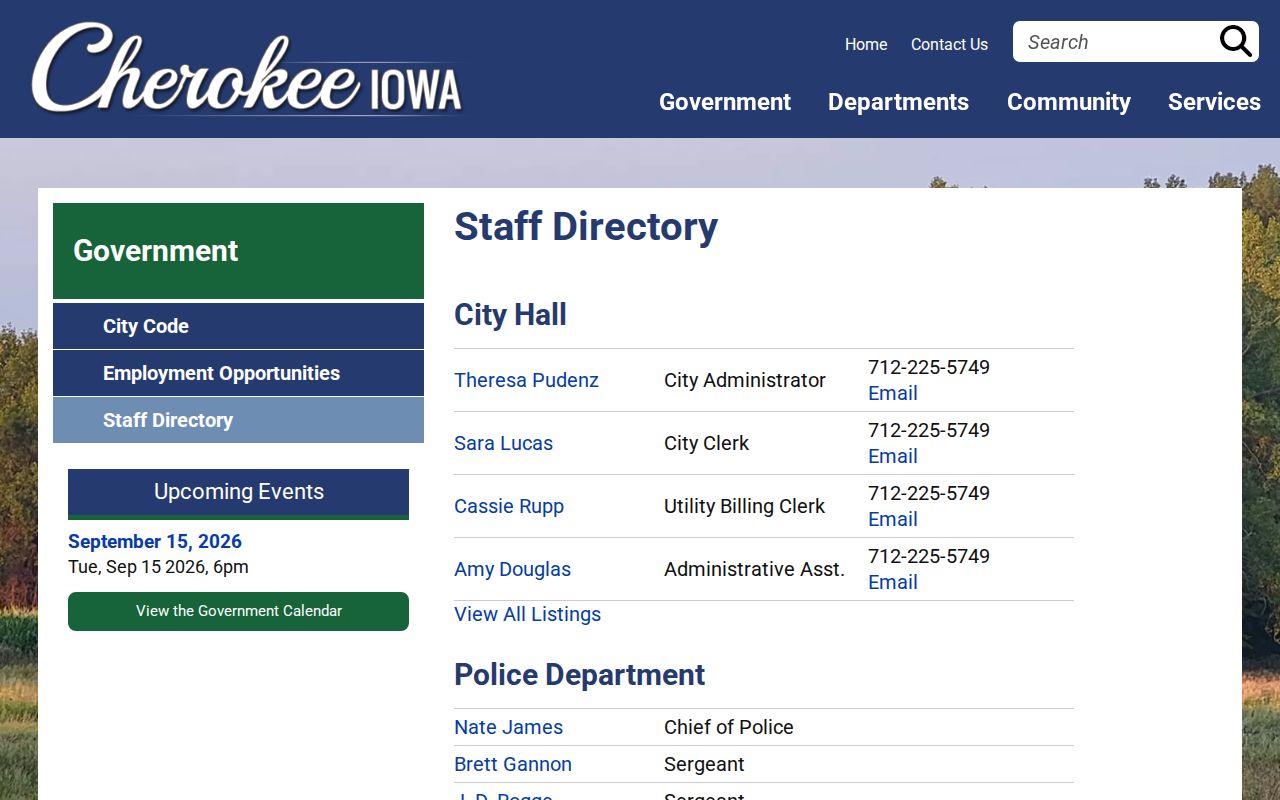
The Iowa Judicial Branch has warned about scams that use threats of arrest, missed jury duty, or supposed warrants to demand quick payment. Verify through a known government address or number. Never trust payment links from unsolicited callers, texts, or email. No court takes gift cards. Send no cryptocurrency or private account data either. The official court scam warning carries the current statewide caution. For Cherokee court questions, use the clerk contact listed on the Judicial Branch county page. For Cherokee police or sheriff service questions, use the official city or county website. The official Cherokee staff directory handles city routing. It lists city contacts, not a warrant result or a person.
A Cherokee warrant question is really a routing problem. The goal is reaching the right public office while sensitive case data stays on the official court or agency system. A claim may arrive after business hours. Save the message. Wait for an independently verified contact unless there is an emergency. A legitimate need to resolve a warrant can be discussed with the clerk, the responsible agency, or counsel, without accepting the caller's payment method or disclosing private financial details.