
Cherokee County Warrant Searches
Your best public starting point is Iowa Courts Online, the Judicial Branch docket index. It reaches public trial-court information statewide, Cherokee County included. It is not a sheriff warrant list. What you see on screen is not the official court record either. A docket may surface a publicly available warrant event, bond entry, court date, or filing, but only the issuing court or the responsible agency can confirm current status.
- Search Iowa Courts Online by name, exact date of birth, case ID, or citation number, selecting Cherokee County when required.
- Review case type, filings, events, status, and bond information without assuming a payment entry recalls a warrant.
- Call the Cherokee County Clerk of District Court at 712-225-6744 about the official case record or courthouse terminal.
- Ask the Sheriff’s Office at 712-225-6737 about agency-held or service information; use a city clerk for parking matters.
- Make a focused records request when those routes cannot identify a releasable record, and seek legal advice from an Iowa attorney.
Cherokee County Warrant Search Modes
The system offers several ways in. For a name search, type at least two letters of the last or firm name; a first name is optional, spelling matters, and a percent sign works as a wildcard. Broad surnames pull in unrelated cases, so weigh county, case type, and dates in Cherokee County before concluding anything. Date-of-birth mode demands the date plus first and last name. Citation search takes a citation number. Keep private identifiers and individual results to yourself.
Quick answer: A case ID is usually the narrowest route when known. A name match alone does not establish identity or live warrant status.
Case-number mode needs the county and case type. The identifier runs 17 characters. These inputs find dockets in Cherokee County; they are not an agency warrant query.
What a Warrant Search Asks For
The official trial-case search changes its fields by mode. Choosing Cherokee narrows results without promising full local coverage. No filter for active warrants only exists.
| Field Label | Type | Required | Notes |
|---|---|---|---|
| Last Name | Text | Yes for name | Two-letter minimum; exact spelling; % wildcard. |
| First Name | Text | No for basic name | Narrows common-name results. |
| Date of Birth | Date | Yes for DOB | Exact date plus both names. |
| Case ID | Text | Yes for case ID | Full 17 characters, county, and type. |
| Citation Number | Text | Yes for citation | New citations may not yet appear. |
Cherokee County Warrant Search Gaps
A blank screen has several innocent explanations. Spelling may be off, the record may predate online coverage, the matter may be confidential or juvenile, or the case may simply not be entered yet. Public trial cases after 1998 are generally online; older material may sit with the clerk. Official help says a case can take a business day to appear, citation posting can take up to 14 days, and payment guidance separately warns of 14 to 21 days. When a known Cherokee County matter is missing, fix the spelling and mode first. Then call the Cherokee County Clerk and ask whether the record is online, on the courthouse terminal, or available by copy request. The goal is the right case and its custodian, not a sweep through strangers' records.
Cherokee County Warrant Search Results
A public result can carry basic case information, filings, parties, lawyers, charges, dispositions, and amounts owed or paid. Depending on the record, it may also show a warrant event, hearing, bond entry, return, or service notation. Some details require a courthouse terminal or subscription in Cherokee County.
| Case ID | A statewide identifier such as COUNTY-TYPE-SEQUENCE; verify every character. |
|---|---|
| Charge or filing | An allegation, event, or document description, not necessarily a final disposition. |
| Issuing court | The Iowa District Court county tied to the case. |
| Bond entry | Type, amount, date, conditions, or posting information when public and applicable. |
| Status or return | A docket status, service, recall, return, or disposition entry requiring current confirmation. |
Cherokee County Warrant Case Types
Case codes keep record types straight in Cherokee County. Iowa materials mark FE for felony, AG for aggravated misdemeanor, SR for serious misdemeanor, and SM for simple misdemeanor. Traffic matters use ST and NT, while SW covers search-warrant cases.
Criminal docket: A public index of court activity, not the restricted wanted-person system.
SW: A search-warrant case type governed separately from an arrest warrant; it does not prove someone is wanted.
Return or service: Documentation about execution or return of process whose timing can differ from present status.
IOWA System: Iowa On-line Warrants & Articles, available only to authorized criminal-justice users.
Cherokee County Warrants: Who Holds What
The Clerk of District Court is the route for local criminal, traffic, misdemeanor, felony, and bond docket questions. Iowa runs a unified trial-court system; the old mayor's, police, and municipal courts are gone. Magistrates handle specified preliminary and limited proceedings inside that system, so Cherokee County has no separate municipal-court warrant database. The Sheriff takes county law-enforcement and service questions, covering Cleghorn, Quimby, Washta, Meriden, and Larrabee. Cherokee, Marcus, and Aurelia list police or city contacts but no city warrant portal. The DPS IOWA System holds wanted-person information for agencies only, with no public login. Federal matters go through the Northern District of Iowa, PACER, counsel, or the U.S. Marshals.
Cherokee County Warrant Record Requests
A narrow request beats asking for "all warrants." Name Cherokee County, give an approximate filing or event date, add a case ID or citation if you have one, specify the docket entry or document, and state a format. The Judicial Branch request page accepts oral or written requests, though complex ones may need writing. Fees for copying, postage, retrieval, review, redaction, supervision, or programming can apply, with an estimate or prepayment possible. The Cherokee County clerk sits at 520 West Main Street, Cherokee, IA 51012, and lists CountyClerk.Cherokee@iowacourts.gov and 712-225-6744. For service or return records held by an agency, ask the sheriff who the custodian is. No Cherokee County warrant search fee, recall fee, sheriff form, or dedicated warrant counter hours are published, so confirm the current procedure before submitting.
Which Warrants Stay Restricted
Iowa Code chapter 22 opens public records while preserving exceptions. Section 804.29 keeps information filed to secure an arrest warrant confidential until the statutory release event. Juvenile records carry separate rules under chapter 232, and chapter 808 governs search-warrant applications and affidavits.
Key rules:
Confidential warrant-securing material does not become public because someone searches a name.
Juvenile matters may be withheld and absent from the public index.
A newly issued, unserved, older, or not-yet-entered matter may be missing; no result is not proof that no warrant exists.
Payment and Cherokee Warrant Status
Paying online fixes only part of the problem. The Iowa court payment page and its ePayment form can find eligible fines and court debt, but neither tool confirms warrant status in a live way. A plea of guilty can follow from some payments. Certain matters still require an appearance, and city parking tickets belong with the city clerk, not the court. Paying does not automatically recall a warrant either, so check with the Cherokee County clerk about the controlling court order before assuming anything is resolved.
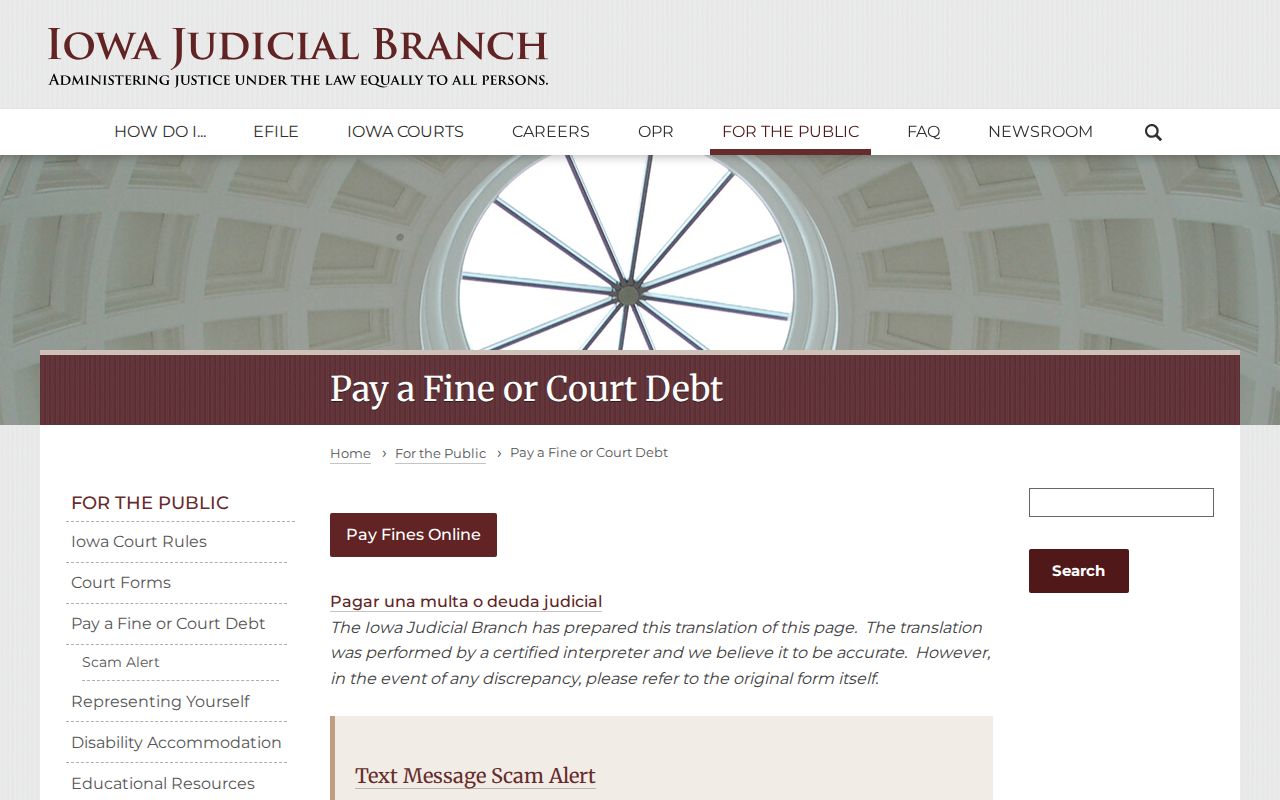
Use the clerk, the secure court site, or an official phone line when money is involved. A June 2026 Judicial Branch warning reports scammers who invoke fines, jury service, or arrest warrants and push payment through unofficial channels. Hang up. The warning matters most when a caller pressures someone to act before anything is verified. Locate the court through its own official page, and rely only on contact details the Iowa Judicial Branch publishes. A receipt proves one narrow fact: the transaction posted. It says nothing about whether an appearance is still required, whether a separate count sits unresolved, or whether a judge has signed a recall order. The Cherokee clerk can point to the public case document that actually controls. When the question turns on interpretation or strategy, an attorney, not a payment vendor or a search result, should advise. Keep your confirmation question narrow. Ask whether the payment shows on the named Cherokee County case, whether the public docket lists a later court order, and whether another appearance is scheduled. If you have a citation number instead of a case ID, say so first. That small step prevents mistaken matches and keeps the payment tied to the right court file in Cherokee County. It also preserves the central limit of any warrant check: a financial transaction, a docket index, and agency service information are separate records that update on different schedules. Write down the date and the office that supplied each confirmation. A later follow-up can then refer back to the same record instead of starting cold.